
Asphalt Driveway Thickness Guide: 2 vs 3 Inches
Understand compacted asphalt depth, the base underneath it, how vehicle loads change the decision, and how thickness affects the tons of asphalt you need.
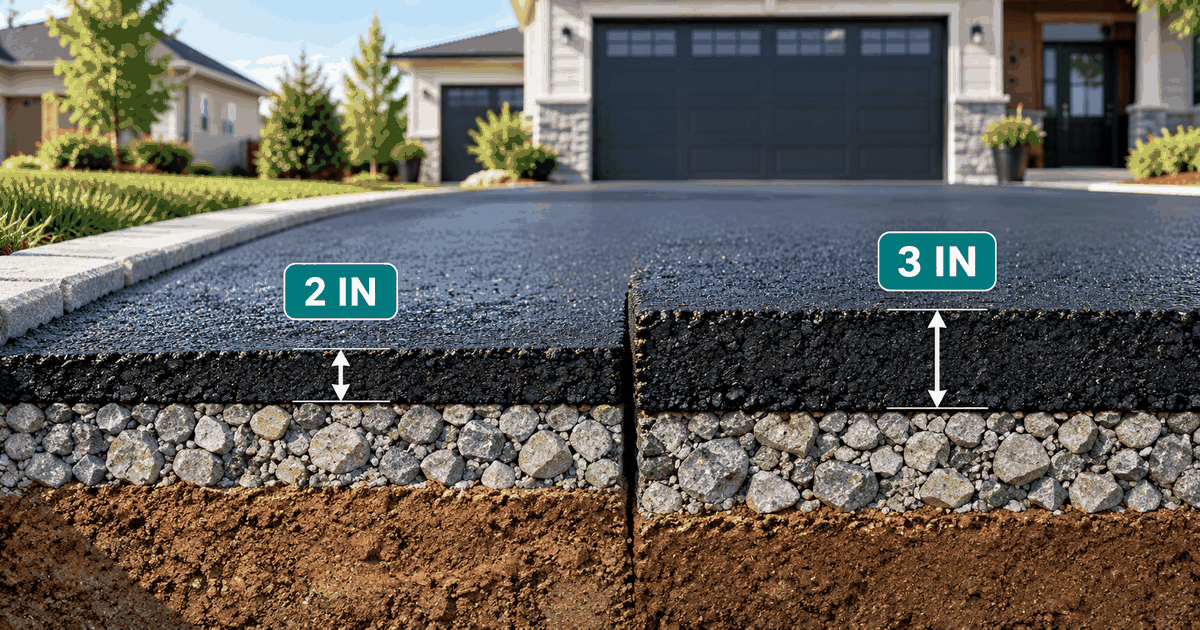
For many residential driveways used by passenger vehicles, two to three inches of compacted asphalt is a common planning range. That number is only part of the pavement design. The soil, aggregate base, drainage, climate, expected vehicles, asphalt mix, and compaction all influence how the finished driveway performs.
If you already know your driveway dimensions and want to see how depth changes the project budget, use the Asphalt Driveway Cost Calculator. This guide focuses on the thickness decision itself so you can understand what a contractor means when a proposal specifies two inches, three inches, or a heavier pavement section.
How Thick Should an Asphalt Driveway Be?
A useful residential starting point is two to three inches of compacted hot mix asphalt over a properly prepared aggregate base. A driveway carrying ordinary cars may not need the same pavement structure as one that regularly supports delivery trucks, an RV, a large trailer, or other heavy vehicles. The right design also changes when the underlying soil is weak or when water cannot drain away from the pavement structure.
The key word is compacted. Asphalt is placed loose and then rolled. When comparing paving proposals, ask for the finished compacted asphalt thickness rather than relying on a vague statement about how much material will be placed before rolling.
2 Inch vs 3 Inch Asphalt Driveway
| Planning point | 2 inch compacted asphalt | 3 inch compacted asphalt |
|---|---|---|
| Typical use | May suit some light residential applications with sound support | Provides a more substantial asphalt layer for residential use |
| Asphalt volume | Baseline | 50 percent more asphalt volume for the same area |
| Material demand | Lower tonnage | Higher tonnage and material cost |
| What still matters | Base, soil, drainage, climate, traffic, mix, and compaction | Base, soil, drainage, climate, traffic, mix, and compaction |
| Best way to choose | Use the complete pavement design and site conditions rather than choosing depth from price alone | |
Moving from two inches to three inches does not make a driveway fifty percent better or guarantee fifty percent more service life. It simply increases asphalt depth and, for the same area, increases asphalt volume by fifty percent. Performance still depends on the layers and conditions below the surface.
Why the Base Under Asphalt Matters
Asphalt is the visible surface, but it does not work alone. The pavement needs stable support underneath it. Existing soil forms the subgrade, while compacted crushed aggregate is commonly used above the soil to create a stronger and more uniform base for the asphalt surface.
A common residential planning range is roughly four to eight inches of compacted aggregate base, but that is not a universal specification. Soft soil, poor drainage, frost conditions, excavation depth, and heavier vehicles can change what is required. If you are estimating aggregate quantities after the base depth has been selected, the gravel calculator can convert the driveway area and depth into a material estimate.
Driveway Layers From the Ground Up
| Layer | Purpose | What to verify |
|---|---|---|
| Subgrade | Provides the underlying soil support for the pavement | Weak or wet areas are addressed before paving |
| Aggregate base | Spreads loads and creates stable support for the asphalt | Material type, compacted depth, grading, and drainage |
| Asphalt surface | Provides the smooth paved wearing surface | Mix, compacted thickness, placement, and compaction |
This is why simply asking whether two inches or three inches is better can miss the most important part of the job. Three inches of asphalt placed over a poorly prepared wet base can still fail, while a properly designed pavement treats the layers as one system.
When Heavier Vehicles Change the Thickness Decision
Passenger cars create a different loading pattern from repeated truck, RV, trailer, or service vehicle traffic. When heavier vehicles will regularly use the driveway, tell the paving contractor before the pavement section is selected. The solution may involve a thicker asphalt section, a stronger or deeper aggregate base, multiple asphalt lifts, or other site specific changes.
Do not assume that adding asphalt on top automatically fixes weak support below. If the subgrade or base moves under load, the surface above it can move and crack as well.
How Thickness Changes Asphalt Tonnage
Thickness directly changes asphalt volume. For the same driveway area and asphalt density, a three inch layer requires one and a half times the asphalt volume of a two inch layer. A four inch layer requires twice the volume of a two inch layer.
| Driveway area | 2 inch asphalt | 3 inch asphalt | 4 inch asphalt |
|---|---|---|---|
| 400 sq ft | About 5.1 tons | About 7.6 tons | About 10.2 tons |
| 600 sq ft | About 7.6 tons | About 11.4 tons | About 15.2 tons |
| 800 sq ft | About 10.2 tons | About 15.2 tons | About 20.3 tons |
| 1,000 sq ft | About 12.7 tons | About 19.0 tons | About 25.4 tons |
These examples use 145 pounds per cubic foot as a planning density and include a five percent quantity allowance. They show the material effect of a chosen thickness, not which thickness your driveway should use. For your own dimensions, the asphalt quantity guide explains the tonnage formula and coverage calculation.
See How Driveway Size, Tonnage, and Cost Work Together
Thickness changes the amount of asphalt your driveway needs, but it is only one part of the final budget. This short Figuring Asphalt video shows how driveway dimensions, asphalt tonnage, thickness, and project cost connect when you are planning an estimate.
Compacted Thickness vs Loose Thickness
This distinction is worth putting in writing before paving begins. Hot mix asphalt is thicker when it is first placed because rolling reduces air voids and compacts the material. A proposal that says only three inches without explaining whether that means loose placement or finished compacted depth leaves room for misunderstanding.
Ask the contractor to state the intended compacted thickness in the proposal. If more than one asphalt layer will be placed, the proposal should also make the lift structure clear.
Drainage Can Matter as Much as Thickness
Water can weaken the support below a pavement and contribute to deterioration. The driveway should be graded so water drains away rather than remaining trapped at the surface or within the pavement structure. Drainage conditions are one reason a general internet thickness cannot replace an assessment of the actual property.
Technical pavement guidance from the Federal Highway Administration explains how moisture, drainage, subgrade, and base conditions affect pavement performance.
What to Ask Before Accepting a Paving Quote
A useful quote should describe more than the final price. Ask what happens to the existing surface, how weak soil will be handled, what aggregate base will be used, the compacted base depth, the asphalt mix, the finished compacted asphalt thickness, and how drainage will be maintained. These details make it much easier to compare two proposals that may otherwise look similar.
If you are still building the overall project budget, our asphalt cost calculator can turn material quantity and local asphalt pricing into a planning figure. Keep material cost separate from the full installed quote because excavation, grading, base preparation, trucking, labor, equipment, and removal can all affect the installed price.
Common Thickness Mistakes to Avoid
One mistake is choosing the thinnest option simply because it has the lowest initial price. Another is assuming more asphalt can compensate for a failed base. It is also easy to compare quotes that use different meanings of thickness or include different preparation work. The useful comparison is the complete pavement section and scope, not one number in isolation.
Another mistake is using a tonnage table to select the pavement design. Tonnage is the result of the chosen area, depth, density, and allowance. Decide the pavement structure from site conditions and expected use first, then calculate the material required.
Frequently Asked Questions
How thick should an asphalt driveway be?
Two to three inches of compacted asphalt is a common planning range for residential driveways carrying passenger vehicles. The correct pavement section depends on the soil, aggregate base, drainage, climate, expected vehicles, and local requirements.
Is 2 inches of asphalt enough for a driveway?
Two inches can be suitable in some residential situations when the supporting base, drainage, soil, traffic, and mix are appropriate. It should not be treated as a universal specification for every driveway.
Is 3 inches of asphalt better than 2 inches?
Three inches uses about fifty percent more asphalt volume than two inches for the same paved area and can provide a more substantial asphalt layer. Whether it is the better design depends on the complete pavement structure and expected loads.
How much gravel base should go under an asphalt driveway?
Aggregate base depth is site dependent. A common planning range is about four to eight inches of compacted aggregate, but weak soil, poor drainage, frost conditions, or heavier vehicles can require a different design.
Does asphalt thickness change the number of tons needed?
Yes. For the same area and density, increasing compacted depth from two inches to three inches increases asphalt volume and tonnage by fifty percent.
Should driveway thickness be measured before or after compaction?
Project specifications should make clear that the stated asphalt thickness is the finished compacted thickness. Loose asphalt is thicker before rolling, so unclear wording can cause misunderstandings when comparing proposals.
Sources and Method
This guide uses common residential pavement planning ranges to explain how asphalt depth affects material quantity and project decisions. The tonnage examples are arithmetic estimates using a planning density of 145 pounds per cubic foot plus a five percent quantity allowance. Technical context for subgrade, base, moisture, and drainage was checked against Federal Highway Administration pavement guidance. Site conditions and local specifications take priority over general online guidance.